All Articles
Legislative and Regulatory Update
August 2006 by Scott Harn


• Supreme Court muddies waterways
On June 19, 2006, the US Supreme Court muddied the waters even further when it comes to deciding whether or not the Army Corps of Engineers has jurisdiction over wetlands that are some distance from navigable bodies of water.
The Clean Water Act was established in 1972 and amended in 1977. It gives authority to the Army Corps of Engineers to regulate the dumping of fill material into the “navigable waters of the United States.”
Over the years, the Corps has extended its reach by attempting to regulate any body of water, including isolated ponds, seasonal washes and irrigation ditches.
In this latest case, the Supreme Court combined two Michigan cases in which the appeals court already ruled against both parties.
The lead case was Rapanos v. United States. Rapanos cleared and filled three parcels that the Corps claims should be regulated as wetlands and are subject to a Clean Water Act permit.
Rapanos was convicted of violating the Act. The Supreme Court denied a review of the case in 2004. The Corps sought several million dollars in fines in a separate civil case, and this is the case the Supreme Court accepted for review.
Rapanos’ property is 20 miles from the nearest navigable waterway, but the Corps maintains that the property is within the drainage system of Lake Huron and two navigable rivers.
The second case, Carabell v. United Stated Army Corps of Engineers, has been combined under the Rapanos case number. The Carabells wanted to fill a portion of their property to build a condominium complex, but the Corps denied them a permit.
Both cases challenged the jurisdiction of the Corps.
Four Justices (Scalia, Roberts, Thomas, Alito) said the Corps had overstepped its authority. Scalia wrote the opinion, stating the Corps acted “beyond parody” by regulating land that contained nothing but storm sewers, drainage ditches and “dry arroyos in the middle of the desert.”
Scalia said the only wetlands subject to federal jurisdiction are those that have “a continuous surface connection” to a navigable waterway and these wetlands must be “relatively permanent, standing or flowing.”
Four Justices (Stevens, Souter, Ginsburg, Breyer) sided with the Corps, going so far as to say that the Scalia group is antagonistic towards environmentalism.
Justice Kennedy did not clearly take either side. While he did remand the case back to the appeals court along with the Scalia group, his opinion was cloudy at best.
Justice Kennedy said the Corps needed to be more specific in defining the tributaries that demonstrate a “significant nexus” to navigable waterways. He said it needed to identify those “categories of tributaries” that were “significant enough that wetlands adjacent to them are likely, in the majority of cases, to perform important functions for an aquatic system incorporating navigable waters.”
The Corps may now try their hand at establishing new rules to incorporate Kennedy’s “significant nexus” test.
The Pacific Legal Foundation, which represented Rapanos, is claiming a win.
“Today’s decision is a victory for balanced environmental protection—common sense and the rule of law have prevailed,” said Reed Hopper, a principal attorney for Pacific Legal Foundation. “The Court rejected the idea that there are no limits on the federal government’s regulatory authority under the Clean Water Act. It is not the role of the federal government to micromanage every pond, puddle, and ditch in our country.”
“This case was about the abuse of the law by federal agencies,” Hopper said. “It was never about clean water.”
The case is Rapanos v. United States, No. 04-1034.
Prospecting for Hardrock Gold - "Eureka!" (Part III)
 A quartz piece was rolled over and there it was, staring right at us—beautiful, coarse gold coming right out of the quartz rock. It was almost the size of a softball, and it looked like over one quarter of it had gold throughout!
That Something Extra
The something extra is adventure. I thank God for my gold fever. It has made so much of this adventure possible and caused my path to cross with many persons who have left fond memories indelibly imprinted in my memory.
The Klamath Mountains
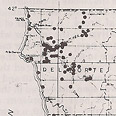 Over 7 million ounces of gold have been produced in the Klamath Mountains of northwestern California, 64% of which has been from placers.
The Bawl Mill
• A Perfect Way to Begin 2000...
• A New Way to Fill City Coffers...
• Americans Pay More...
• Mother always told you to wear clean underwear...
Gold Point, Nevada—A One-Man Mining Town Restoration
Almost 200 miles northwest of Las Vegas, Nevada, Gold Point was developed initially as a gold mining community in 1868. Like most mining camps, it experienced a typical boom-to-bust cycle, and by 1882, Gold Point was clearly on its way to becoming just another abandoned ghost town.
Ask The Experts
• Two questions: Is fool's gold magnetic? And how do you go about filing a miing claim?
PLP Update
During discussions with other property rights advocates and members of the current administration, Karen Budd-Falen’s name was mentioned many times as a possible director for the Bureau of Land Management (BLM).
Subscription Required:
The Bawl Mill
• Microbes Play Role in Gold Creation
• Osisko Exploration: Redeveloping the Historic Malartic Mining Camp
• Prospecting at Moore Creek
• The Small Hardrock Mill—Part II
• The Treasure Detective—Part II
• 2006 National Mining Hall of Fame Inductees
• The Fairbanks Goldfields
• Elections May Bring Rush to Republic of Congo
• Melman on Gold & Silver
Free: